RED3 Monitor
Implementation of Renewable Energy Directive
Renewable Strategies supports organizations in translating the Renewable Energy Directive (RED3) into practical actions and compliance strategies. We help clients interpret complex regulatory requirements, assess impacts on operations, and develop tailored plans to meet national and EU obligations. By combining policy insight, advocacy, and strategic guidance, we ensure your organization not only complies but also leverages opportunities in the energy transition.
Disclaimer: The information on this webpage is based on publicly available legislative developments and is provided for general informational purposes only. Renewable Strategies does not accept any responsibility or liability for the accuracy, completeness, or use of this information.
Dutch implementation explained!
The Dutch implementation of the Renewable Energy Directive is structured in three layers: the Act establishes the legal foundation and strategic direction, the Decree translates this framework into actionable rules, and the Regulation defines operational requirements to ensure effective execution and compliance.
Published: May 26, 2025 (status: awaiting Senate vote on March 31, 2026)
The Act amends the Environmental Management Act (‘Wet Milieubeheer’) to implement the revised Renewable Energy Directive (RED3) for the transport sector. It raises renewable energy targets to reduce reliance on fossil fuels and forms part of the wider EU package aimed at achieving climate neutrality by 2050.
The Act introduces the following provisions, with further detail laid down in the Decree and Regulation:
- A sector-specific system for renewable energy in transport covering road, inland shipping, and maritime shipping (excluding aviation) with annual obligations per sector, limited cross-sector credit use (not for road), and the abolition of multipliers.
- Fuel suppliers must in principle meet their annual obligation with tradable emission reduction units (EREs) recorded in the Register of Renewable Energy in Transport for renewable energy delivered within the relevant sector. The Decree further details which sector can fill what part their obligation with cross-sector credit use.
- EREs for RFNBO’s and Electricity. The Decree sets out which sectors can generate how much of these types of EREs.
- A correction factor for EREs of the category ‘other’. The Regulation sets the level of this correction factor.
- “Crediting service providers” to enable small electricity suppliers and individuals to register delivered EREs of the carport ‘electricity’, with further rules set out in the Decree and Regulation.
- Refinery reduction transport fuels, promoting renewable non-biological fuels in refineries, with further details in the Decree and Regulation.
The Act was amended accordingly after the parliamentary vote on October 2, 2025:
- Correction factor for the refinery route remains at 1 at least until 2030.
- Clarified which types of bio-ethanol count as liquid biofuel (adjusted after vote: now applied via Art. 9.7.4.2(c) so ethanol purity is assessed at purchase (from 1 Jan 2026) rather than delivery, aligning with the original intent).
Link to amended Act.
Published: June 23, 2025 (status: awaiting Ministry response on Council of State advisory)
This Decree amends the Energy in Transport Decree (RED3) and the Fuels and Air Pollution Decree (FQD), to provide actionable rules to put into practice the framework set out in the Act.
The Decree introduces the following rules, with some further details laid out in the Regulation:
- The system will no longer be based on delivered renewable energy (content) but on reduced (CO₂) chain emissions, which is the reason the Dutch double-counting system will disappear.
- Fuel Transition Obligation is set for Road, Shipping and Inland: ‘Annex IXb’ excluded in shipping (limited in road and inland), ‘Conventional’ only allowed in road (with a limit), ‘Annex IXa’ sub-target in road, and ‘RFNBO’ sub-target in all sectors. The levels of the obligation are shown in the overview below, including the levels for cross-sector credit use.
- Refineries can earn RARE-credits for using renewable non-biological fuels (RFNBOs), which suppliers may use only to meet the sector-specific sub-obligations for RFNBOs.
- A new obligated party: companies supplying electricity to road vehicles and mobile machinery via swappable batteries, while also requiring that small annual quantities of supplied electricity be booked through a ‘booking service provider’, to reduce administrative burdens that outweigh the benefits for small businesses and households.
- FQD is amended to raise the maximum biodiesel (FAME) blend in diesel from 7% (B7) to 10% (B10), while obliging suppliers to continue offering B7 due to the large number of vehicles not compatible with B10.
- Maritime fuel suppliers must meet annual CO₂eq reduction targets using emission and refinery reduction units, with fuel quantities and types recorded per MARPOL Annex VI and the Air Pollution Fuels Decree.
The Council of State‘s advice published on 23 February 2026:
- Raises concerns about legal certainty.
- Questions the enforceability of obligations that have not yet entered into force.
- Advises clarifying how the 42.5% national target and sectoral sub-targets relate to the 45% CO₂eq lifecycle emissions reduction target.
- Questions the absence of sub-targets for the rail and aviation sectors.
- Raises concerns about the enforceability of certain obligations by the Dutch Emissions Authority (NEa).
Link to Decree.
Link to Fuel Transition Obligation levels for 2026-2030.
Link to Council of State advice.
Published: September 18, 2025 (status: government has responded to consultation input, pending internal review)
This Regulation amends the Energy for Transport Regulation (RED3) and the Fuel Air Pollution Regulation (FQD) in order to implement various policy developments concerning the renewable energy framework in the transport sector.
The Regulation introduces the following rules and operational requirements:
- The double counting of biofuels from specific feedstocks is abolished.
- The option to administratively “green” natural gas from the transmission grid using Guarantees of Origin (GoOs) is removed.
- Fuel supply reporting is expanded to additional transport sectors; verification to end-use now also applies to inland and maritime shipping, and bio-verification is introduced.
- A corrective factor of 0.5 is applied to biofuels from feedstocks in the ‘other’ category (animal fats, category 3).
- The regulation clarifies how the energy contribution of emission reduction units must be determined.
- New provisions are added regarding the refinery reduction units (registry), covering reporting obligations and the use of refinery reduction units (RAREs) for sub-target compliance. A corrective factor of 1 (no correction) will apply to ensure refinery pathways contribute to scaling electrolysis capacity in the Netherlands.
- New rules for ‘booking service providers’: they must hold at least 200 mandates, or alternatively ensure a minimum annual booking volume of 2 million kWh of electricity per booker.
- A ‘booking service provider’ may book on behalf of a legal or natural person only with a signed authorization valid for at least one full calendar year, containing specified company/personal details, EAN codes, and authorizations for the Emissions Authority and booking verifier.
- ‘Booking verifiers’ must, among other tasks, visit the registered office of the booking service provider during the initial assessment.
- Annex 5 is updated to align the listed feedstocks with Annex IV of CIR 2022/996, and the definition of “FAME end-distillation residue” is expanded to include Annex IXa feedstocks in addition to IXb. It will also become mandatory to specify the original feedstock of FAME end-distillation residue on the proof of sustainability.
- Market participants must enter data correctly and on time into the Union Database (UDB), retain data and supporting documents for at least five years, and undergo verification by the certification body of their sustainability scheme or voluntary scheme.
- New verification rules are introduced for end-use across maritime and inland shipping, biomass, and various fuels via booking verification.
The government published response to all consultation input on 19 December 2025 (expected amendments):
- Article 2: Standard values can be applied for the lower calorific value, in line with Annex II of the FuelEU Maritime Regulation.
- Article 2: References to EN ISO 3170 and EN ISO 3171 are added.
- Article 26: Wording is editorially adjusted to align with Article 2(c).
- Annex 3, Section 3a: A missing set of requirements for Guarantees of Origin (GOs) is added (correction of an editorial error).
Link to Regulation (incl. Annex 5 feedstock list).
Link to government response to consultation.
Deadline: May 21, 2025 (expected: retroactively January 2026)
The Netherlands is running behind schedule with the national implementation of the Renewable Energy Directive (RED III). The Dutch government is still aiming to have the framework in place retroactively by January 2026, but the legislative process is still ongoing:
- May 21, 2025 – Deadline implementation European Union
- May 26, 2025 – Implementing Act RED III published
- June 18, 2025 – Implementing Act RED III deemed ‘not controversial’ after fall of Dutch cabinet
- June 23, 2025 – Decree RED3 published
- July 16, 2025 – Parliamentary questions submitted
- July 24, 2025 – European Commission opened infringement procedure against The Netherlands
- September 4, 2025 – State Secretary sent answers back to Parliament
- September 18, 2025 – Regulation published for consultation
- September 29, 2025 – Debate scheduled in Parliament
- October 2, 2025 – Vote in Parliament (law has passed)
- November 4, 2025 – First round of Senate questions
- January 2026 – Target date for full implementation (retroactively)
- January 20, 2026 – Second round of Senate questions
- February 23, 2026 – Council of State (RvS) publishes consultation of final Decree
- March 24, 2026 – Senate discussion
- March 31, 2026 – Senate vote
- TBD, April 2026 – Published legislation in Dutch Journal ‘Staatsblad’ (expected)
Link 1 + Link 2 to Parliamentary questions and answers.
Link to Parliamentary timeline.
Link to consultation (Regulation).
Link 1 + Link 2 to Senate questions and answers.
Link to Senate timeline.
Link to Council of State advice (Decree).
Implementation: January 2026 (expected)
With the implementation of the revised European Renewable Energy Directive (RED3), Dutch law and regulation are moving away from measuring delivered renewable energy and toward measuring chain emission reductions. As a result, the Renewable Fuel Units (HBE) will be replaced by Emission Reduction Units (ERE).
- Definition of an ERE: An ERE represents 1 kg CO₂-equivalent emission reduction in the fuel supply chain compared to the fossil reference.
- Obligation: Fuel suppliers will no longer meet a requirement based on renewable energy content (GJ) but instead on CO₂-equivalent chain emission reductions.
- From 5 HBEs to 16 EREs: The five HBE categories (Annex IXa, Annex IXb, RFNBO, Other – including electricity, and Conventional) will be replaced under RED3 by 16 ERE categories, divided across different sectors:
- Road (LREs): Annex IXa, Annex IXb, RFNBO, Electricity, Other, Conventional
- Shipping (ZREs): Annex IXa, RFNBO, Electricity, Other
- Inland (BREs): Annex IXa, Annex IXb, RFNBO, Electricity, Other
- Refineries (RAREs): Refinery-specific
- Calculation method: Because EREs are tied to emission reductions rather than energy content, calculation rules change. Standard emission values are available for many fuel types; others require RED-compliant emission reduction calculations under Implementing Regulation 2022/996.
- HBE to ERE conversion: The final HBE year-end is 1 May 2026. Remaining HBEs will convert to EREs at a fixed factor of 46 ERE per HBE.
- Sector allocation: Converted EREs will be distributed across sectors (e.g. land, maritime – but not aviation) based on 2025 bookings, using market-wide distribution. Allocations will be published in March 2026.
Link to website Dutch Emission Authority (NEa).
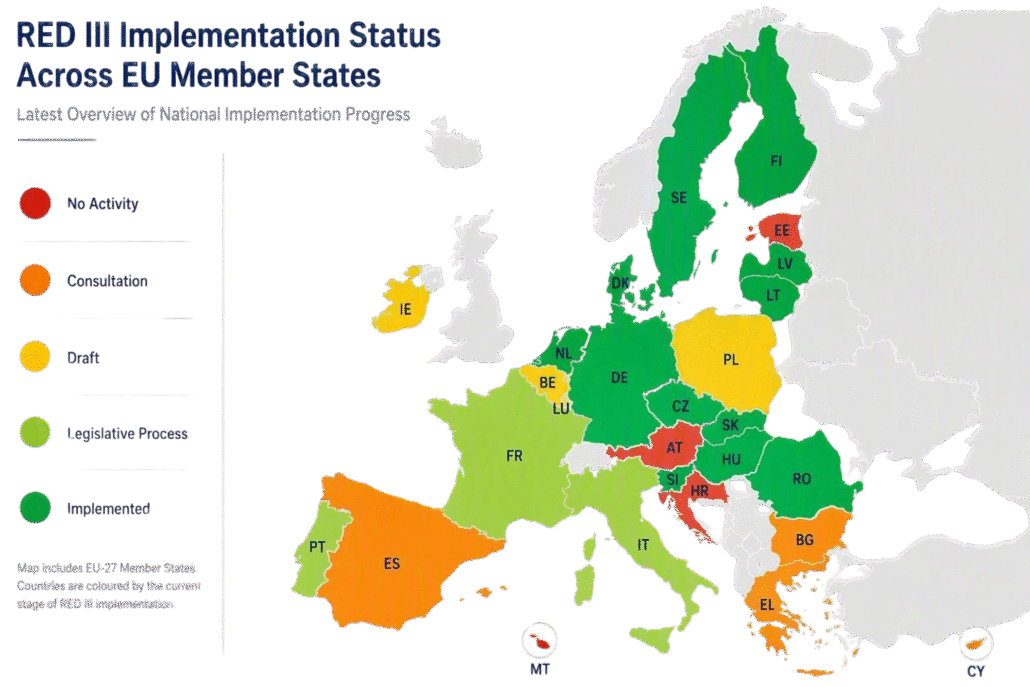
European RED3 tracker (being updated)

Contact Info
Let’s Chat!
Get in touch with us to discuss your advocacy needs.
We are happy to explore how strategic policy insight and targeted engagement can support your organization in navigating the energy transition.